Recent operational feedback has highlighted a major challenge. Command posts must remain mobile, units are increasingly dispersed across the battlespace, and communication systems must continue to operate in contested and degraded environments. Maintaining command continuity while preserving operational mobility is now a key requirement for military forces.
Lessons learned from recent conflicts have demonstrated that static command infrastructures are becoming increasingly vulnerable. Operational headquarters may need to relocate several times a day to reduce the risk of detection and targeting. This evolution is driving demand for deployable communication solutions capable of supporting command-and-control (C2) operations wherever forces are deployed.
Private 5G for defense offers a new approach to tactical communications. By providing high-capacity, low-latency and secure connectivity directly at the tactical edge, deployable private 5G networks enable armed forces to extend C2 services, operational applications, and situational awareness capabilities closer to the mission.
Operational demonstrations conducted in realistic deployment scenarios have shown how private 5G can support mobile command posts, crisis management operations, convoy protection, logistics hubs, and forward-deployed medical facilities while addressing five critical military requirements: ruggedness, reliability, survivability, security, and interconnectivity.
Why private 5G for defense?
Private 5G is not simply another communication technology. It is an operational enabler that supports information superiority across the battlespace.
Key benefits include:
- Command continuity in contested environments
- Secure tactical communications
- Real-time situational awareness
- Rapid deployment of mobile command posts
- Integration with satellite and hybrid communication networks
- Support for connected sensors, drones, and autonomous systems
- High-capacity connectivity for C2 applications
Ruggedness: rapidly deployable tactical communications for mobile operations
Military communications must adapt to manœuvre, not constrain it.
Recent conflicts have demonstrated that command posts can no longer rely on static infrastructures. To preserve operational effectiveness and reduce exposure to enemy targeting, headquarters elements must be capable of relocating rapidly while maintaining access to critical information systems.
Obvios private 5G enables a new command post architecture. Instead of deploying extensive wired infrastructures, C2 applications, servers and operational tools can remain distributed across protected vehicles while a tactical 5G bubble provides the local connectivity layer.
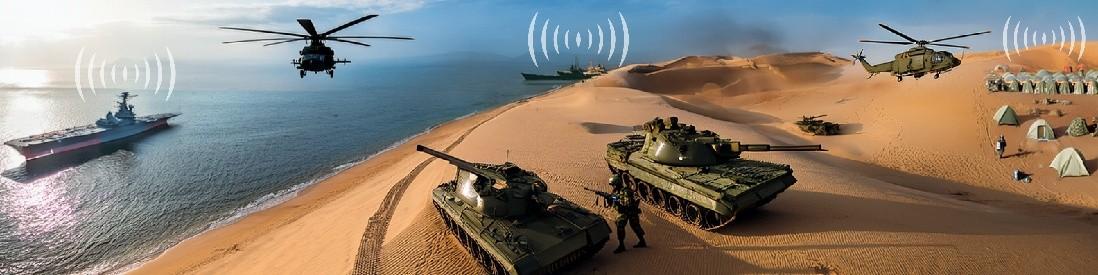
This approach is particularly relevant for mobile command posts where computing resources remain onboard vehicles while operators maintain access to critical applications through secure wireless connectivity.
Designed for autonomous deployment and operation, Dome in a Box can be activated within minutes by operational personnel. Packaged in a ruggedized format and designed for harsh operational environments, it significantly reduces deployment time while supporting the mobility requirements of modern military operations.
Reliability: maintaining command and control connectivity in degraded environments
The value of a communication system is measured by its ability to deliver service when it matters most.
Operational demonstrations showed how a deployable private 5G network can support mission-critical applications including secure messaging, voice and video communications, push-to-talk services, operational mapping, geolocation, and real-time situational awareness tools.
Our private 5G tactical bubble supports hybrid communications, enabling tactical users to leverage satellite, terrestrial and civilian communication infrastructures when required. This flexibility helps maintain command continuity even when dedicated military communication resources are unavailable, degraded or saturated.
The ability to combine private 5G with satellite backhaul and existing communication networks creates a resilient communication framework capable of adapting to operational constraints while ensuring continuity of service.
By bringing secure connectivity directly to the operational area, Obvios private 5G enables commanders and deployed units to maintain access to critical information and decision-support systems throughout the mission.
Survivability: low-signature tactical communications for contested environments
In modern warfare, every electromagnetic emission can become a potential source of detection.
Field experiments conducted with advanced spectrum monitoring systems demonstrated that low-power private 5G deployments are significantly more difficult to detect than conventional public cellular infrastructures. Operating at substantially lower transmission power, tactical 5G bubbles can blend into a congested electromagnetic environment, reducing their visibility to hostile monitoring systems.
This reduced electromagnetic footprint contributes directly to force protection and command post survivability.
The ability to rapidly redeploy communication assets further strengthens operational resilience. Mobile command posts can maintain connectivity while changing location, reducing the risk associated with prolonged exposure.
Private 5G also offers resilience advantages in degraded navigation environments. Tactical deployments can operate with local timing references and synchronization mechanisms, reducing dependency on satellite navigation signals that may be affected by jamming or spoofing activities.
Additional demonstrations explored the integration of 5G radio access equipment aboard tethered drones. By elevating the radio node above the battlefield, commanders can temporarily extend tactical coverage while keeping critical command infrastructure protected on the ground.
Such capabilities open new perspectives for reconnaissance missions, convoy protection and temporary command posts operating in complex terrain.
Security: protecting military communications and operational data
Operational superiority depends on trusted information and secure communications.
Obvios Private 5G incorporates robust security mechanisms including strong authentication, encrypted communications and strict access control. These capabilities help protect sensitive operational information while ensuring that only authorized personnel and devices can access the network.
Security, however, extends beyond encryption. Physical isolation alone does not guarantee cybersecurity. Modern tactical communication systems must also be capable of detecting and responding to cyber threats.
Integrated monitoring and incident response capabilities enable operators to identify suspicious activities and react quickly, even in disconnected or resource-constrained environments. Embedded security functions can generate actionable alerts directly within the operational environment, helping personnel make informed decisions without requiring dedicated cybersecurity expertise.
This secure connectivity layer can also support connected sensors, autonomous systems and unmanned platforms while maintaining confidence in the integrity and confidentiality of operational data.
Interconnectivity: linking tactical 5G networks with fixed and mobile TOCs
Modern military operations rely on the seamless flow of information between deployed forces and command structures.
Private 5G enables the rapid deployment of a secure communication environment close to the mission area while maintaining connectivity with fixed and mobile Tactical Operations Centers (TOCs). Tactical units operating at the edge can access the same operational picture as commanders located in headquarters, mobile command posts or crisis management centers.
Operational demonstrations showed how a tactical 5G bubble can support the exchange of voice, video and operational data between deployed personnel and remote command centers through hybrid backhaul infrastructures combining satellite and terrestrial communications.
This capability is particularly valuable for mobile command posts that must remain connected while preserving mobility and survivability. By providing a high-performance IP connectivity layer, the Obvios private 5G bubble facilitates the integration of C2 applications, operational mapping systems, collaborative platforms and situational awareness tools across the chain of command.
Rather than replacing existing communication systems, the Obvios deployable private 5G bubble acts as a complementary layer capable of leveraging military, satellite and civilian infrastructures depending on operational requirements.
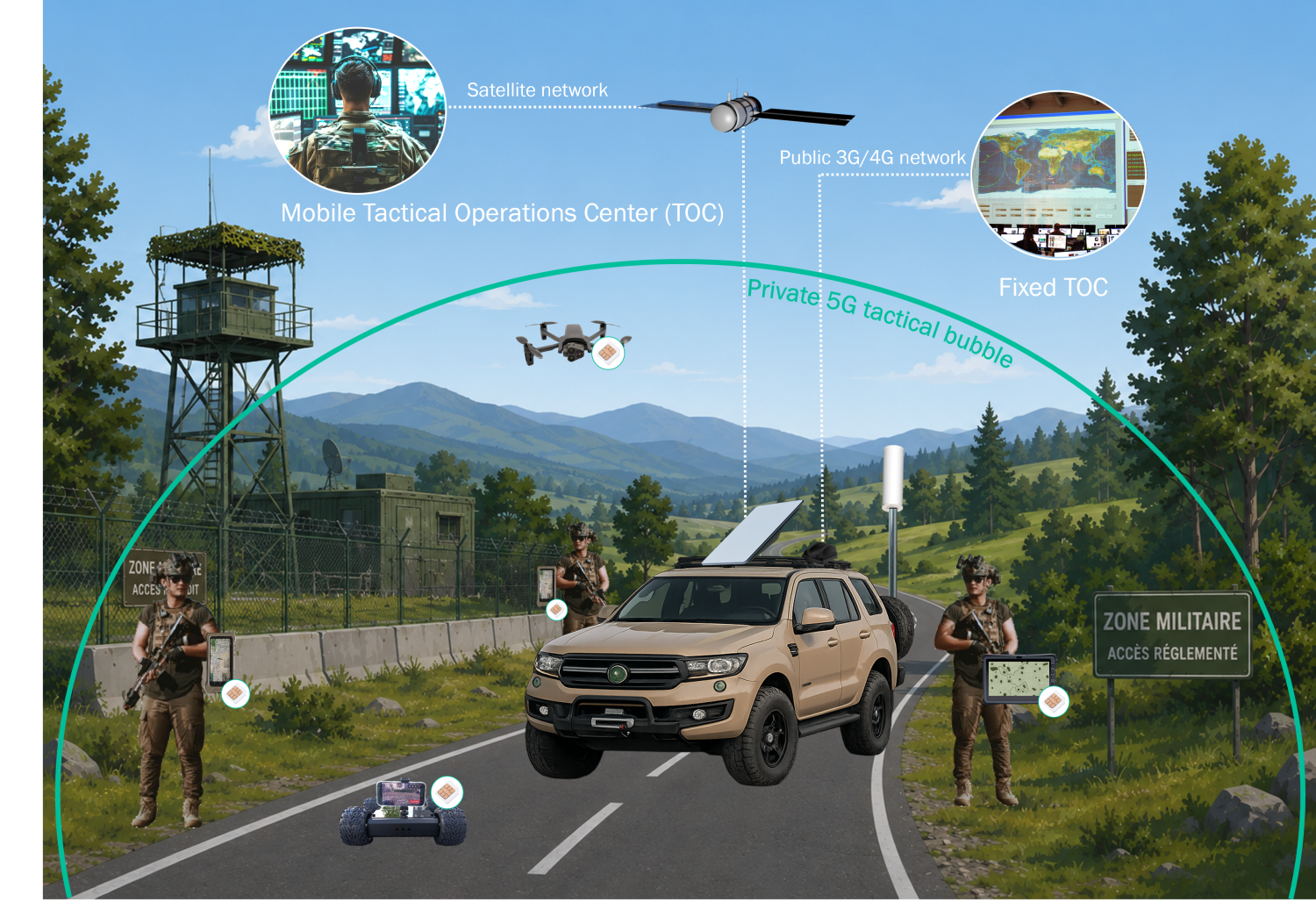
Its IP-native architecture also simplifies interoperability with existing communication infrastructures and coalition systems, enabling the secure exchange of information with allied forces and partner organizations when required.
The result is a resilient communication framework that extends the digital reach of fixed and mobile TOCs while ensuring command continuity throughout the mission.
Dome in a Box: a sovereign private 5G solution for modern military operations
Military organizations require communication systems that can be deployed rapidly, operate reliably, and support command continuity in dynamic operational environments.
Dome in a Box has been designed to meet these requirements. Combining sovereign private 5G technology, ruggedized deployment, hybrid connectivity and secure communications, it enables armed forces to establish a trusted digital environment wherever the mission takes them.
Ready for deployment within minutes, compatible with satellite, fixed and mobile communication infrastructures, and designed for operation in demanding environments, Dome in a Box provides the flexibility required by modern defense and security missions.
From mobile command posts and crisis management centers to logistics hubs, convoy protection and forward-deployed medical facilities, Dome in a Box delivers the tactical connectivity needed to support modern C2 operations at the edge of the battlefield.
As military forces continue to digitalize operations and increase operational mobility, deployable private 5G networks are emerging as a key component of future tactical communications architectures. Dome in a Box is helping bring that capability closer to operational reality.
Discuss your operational requirements
Deployable private 5G networks are becoming a key enabler for mobile command posts, tactical communications and mission-critical operations.
If you would like to learn more about Dome in a Box, discuss a specific operational challenge or explore a demonstration tailored to your requirements, our experts are available to help.
Contact us to start the conversation or request a live demonstration of Dome in a Box in an operational scenario.